Improving responses: how communities power anticipatory action
Most crises announce themselves. The river has been rising for three days. Millet prices have been creeping up for a month. Several families on the same street have fallen sick with diarrhoea. The people living there can see it happening. The information exists; it just does not reach the people who could act on it, at least not in time.
Anticipatory action rests on a simple shift: act on a forecast or an early signal, before the shock hits, rather than once the damage is done. Every day gained counts. It is the difference between distributing chlorine before an outbreak takes hold and treating patients after; between moving stocks to safety before a flood and replacing them after; between protecting seed before the lean season and watching it get eaten.
What anticipatory action often lacks is ground truth: regular, village-level data that comes straight from communities. That is exactly what the SOLIS Bot provides.
Where the bot fits in an anticipatory action protocol
The SOLIS Bot does not replace your protocol. It plugs into it, and there are two ways that can play out.
- Your protocol is already defined: indicators, thresholds and frequencies are set. The bot simply makes that monitoring routine and reliable.
- You are starting from scratch: you first need to choose what to watch. The rest of this article walks through ready-to-adapt examples.
Either way, the bot brings four functions that work as one:
- Surveys gather what communities observe, on a set schedule.
- The early warning system checks responses against pre-agreed thresholds and notifies your team the moment one is crossed.
- Broadcasts send prevention or warning messages, only ever after a person has signed them off.
- The information center stays open day and night, and a sudden spike in visits to a page such as "water and diarrhoea" becomes a signal in its own right.
The real value lies in the early warning system. It is what turns data collection into the ability to act early.
Two audiences, built-in cross-checking
Surveys can go to two distinct groups:
- households and farmers, with short, closed questions;
- community focal points, with more specific questions that call for informed observation.
Comparing the two gives you a first cross-check inside the tool itself. It also lets the bot do two jobs. It can pick up an early signal: a scheduled survey, measured against a threshold, triggers a notification. And it can verify a report from the field: when a team flags an event, a short form goes straight out to focal points in the area, so the alert is confirmed or ruled out within hours, before any resources are committed.
Asking the right questions
An early warning system is only as good as its questions. Five rules apply.
- Three to five questions per form, no more. Beyond that, response rates collapse.
- Stick to what people can see. Respondents answer from what they observe at home, at their water point or in their fields. No measuring, no counting.
- Make every signal checkable. Each data point should be comparable with at least one other source.
- Perception counts. "More expensive than last month" or "hotter than usual" is enough. Precision can come from elsewhere.
- Do no harm. Collect only what you need, after a risk analysis. Nothing about armed groups, no individual medical data.
A threshold, a notification, a human decision
A threshold is a value agreed in advance. It works best on yes/no questions: you count matching answers within an area over a set period. For each indicator, the team fills in a short sheet that settles seven questions.
| Item | Question to settle | Example, to adapt |
|---|---|---|
| Area | At what geographic level? | Village, neighbourhood, health area |
| Window | Over how long do we count? | 7 days for weekly monitoring |
| Minimum base | How many answers before drawing conclusions? | 5 responses in the area |
| Watch threshold | When do we look more closely? | 20% matching answers |
| Alert threshold | When do we notify the team? | 30% matching answers |
| Immediate check | Can a single answer trigger verification? | Yes, for the most serious signals |
| Recipients | Who gets notified? | MEAL and programme coordinators, technical lead, project manager |
These numbers are starting points. Each mission calibrates them to its context and revisits them after the first rounds of data.
One rule has no exceptions: the bot never decides on its own. A crossed threshold sends a notification to your team, never an automatic message to communities. Every broadcast is approved by someone named in advance.
Messages people understand, and pass on
When a message goes out, it has to land the first time and travel. Four principles shape how it is written.
- Say who is speaking: "This is a message from SOLIDARITÉS INTERNATIONAL Maroua", not an anonymous alert.
- Name the time frame: "over the past 7 days", not "right now".
- Give concrete instructions: "wait 30 minutes", not "allow enough treatment time".
- Ask people to share it, always at the end.
Cholera: catching the signs before the outbreak peaks
Cholera surveillance relies on public health centres. It misses people who never seek care, and those who turn to private or traditional providers, which in cities can be the majority. Below district level, the data is rarely reliable. The bot fills that gap with signals straight from households, days to weeks before the peak.
In high-risk periods, a weekly five-question survey is enough:
SOLIDARITÉS INTERNATIONAL
- In the past 7 days, has anyone in your home had severe watery diarrhoea?
- Are several people around you sick at the same time?
- Was the water your family drank today treated?
- In the past 15 days, has your water point flooded, or has dirty water got into it?
- Is the nearest health centre open and reachable?
An alert is built on diarrhoea cases combined with aggravating factors, never on aggravating factors alone. Some answers, such as several sick people in one household or a contaminated water point, trigger an immediate check on their own.
Then a clear procedure takes over. Notification is automatic. The SOLIS Bot focal point consolidates responses within 24 hours, the WASH focal point cross-checks with community focal points and health actors within 48 hours, and the programme coordinator decides within 72. If the alert holds, a message goes out to the area in its own languages:
This is a message from SOLIDARITÉS INTERNATIONAL Maroua. Several cases of diarrhoea have been reported in [area] this week. For the next 7 days, drink only treated water: one chlorine tablet per 20 litres, then wait 30 minutes. No chlorine? Boil your water. If someone at home has severe diarrhoea, give them plenty to drink and go to the health centre. Please share this with your neighbours.
As soon as a case is confirmed at a health facility, the mission switches to its targeted response protocol. The two work in sequence: one detects, the other responds.
Food insecurity: filling the gap between assessments
Access to food rarely collapses overnight. It erodes over weeks, sometimes months, which makes this the longest anticipation window and the one where early action pays off most. Reference analyses exist: the IPC classifies areas twice a year, and market monitoring such as REACH's JMMI tracks prices. Between rounds, though, teams are often working blind.
The bot adds a monthly reading, on a fixed date, across four signals:
- the perceived price of staple foods against last month, and whether they are available at all;
- access to farm inputs such as seed, fertiliser and animal feed;
- household hunger, using established wording (Household Hunger Scale, rCSI);
- crop or livestock losses at the end of the season.
Two cautions matter. A perceived price is not a recorded price: it tells you prices are rising, not why. And a survey must never be tied to a distribution. If people think their answer affects who gets aid, they will answer accordingly. The invitation says so plainly:
This is a message from SOLIDARITÉS INTERNATIONAL Maroua. It's time for our monthly check-in on markets and food: 5 questions, under two minutes. It's free, your answers are not linked to your name, and they have no bearing on any assistance.
Here the clock runs in weeks, not hours. The signal is consolidated over three cycles, checked against market price monitoring, and put to a decision within three weeks.
Floods: when every hour counts
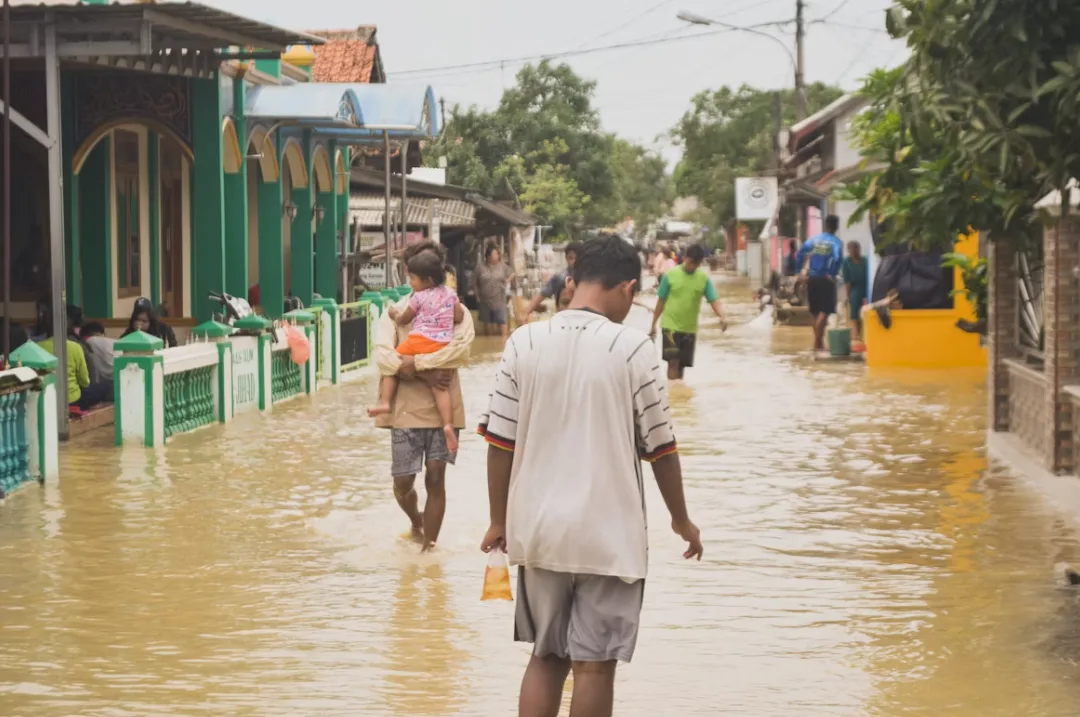
With floods, the window is measured in hours, sometimes days. Where there are no gauging stations, residents see what instruments cannot: rain that will not stop, a river about to burst its banks, water pooling where it normally drains away.
Three "yes" answers to "does the river look about to overflow?" from the same area within 24 hours are enough to trigger an immediate check. The procedure then tightens: focal points verify within two hours, sending a photo if they can do so safely; the programme coordinator decides within four; the warning goes out within the hour; stocks are secured and bases alerted the same day.
This is a message from SOLIDARITÉS INTERNATIONAL Maroua. Warning: the river is rising fast in [area] and heavy rain is forecast. In the next 24 hours, move your documents, seed and food somewhere safe. If you need to leave, leave before dark. Share this message now.
The bot never replaces national warning systems: every message points to official guidance where it exists. And once the water recedes, the health risk begins, since wells are often contaminated even when the water looks clear. Cholera monitoring picks up from there.
Drought: tracking the gap with the calendar
Drought creeps in over weeks. What matters is the gap between the expected farming calendar and what is actually happening in the fields. Farmers and herders see it first: late rains, a dry spell mid-season, wilting crops, falling well levels, pasture that no longer feeds the herd.
One question makes all the difference: when a water point runs dry, is the water table low, or is the pump broken? The two call for completely different responses. In the same way, crop losses caused by pests are not a drought signal.
To avoid false alarms, an indicator has to cross its threshold on two consecutive survey rounds. The signal is then weighed against the farming calendar and seasonal forecasts, and food security monitoring takes over.
Know the blind spots
A good early warning system is honest about its limits.
- One signal is not an alert. What counts is a cluster of matching answers in the same area over the same period.
- The bot only reaches people with a phone who have given consent. Access varies by gender, age and income, and those gaps have to be factored into how results are read.
- Wording shapes answers. The local term for diarrhoea, for instance, should be tested with the community before the first survey goes out.
- The bot replaces neither the IPC, nor epidemiological surveillance, nor national systems. It fills the gaps they leave, in time and on the map.
Where to start
There is no need to launch everything at once. Three steps are enough:
- Pick one hazard, the most relevant for your area, guided by your mission's anticipatory action protocol.
- Name the people who will receive notifications, and the one who will approve broadcasts.
- Fill in a threshold sheet for each indicator you choose, during the scoping workshop.
The rest takes shape with use: thresholds get sharper, questions get clearer, the network of focal points grows stronger. Want to set up an early warning system with the SOLIS Bot? Write to solisbot@solidarites.org.